Thursday, December 27, 2012

My Host Family (11/6/12)

 
Most of my blogs have been written about the crazy experiences and cultural observations that I’ve gone through during my time in Chuuk. I have drooled over the untouched beauty of tropics, complained about the backwardness of society, and chronicled the daily hiccups of happiness and confusion that have been my constant companions. These tidbits of writing have given a decent overall picture of my life, but I have often left out one extremely important element. I have focused on the things and places of Chuuk, but the part of these islands that truly make them special are the people. The people of Chuuk are undoubtedly unique amongst the varied cornucopia of cultures in the world, and the relationships that I have forged with these people have come to define my experience in Micronesia.
My assignment in Peace Corps was to try to better the local community through education and development projects, but I believe my influence can best be seen within the personal connections that I have made with individuals. And while I have had a significant impact on many peoples’ lives, the way that they have touched my soul and changed my thoughts has far outweighed my supposed humanitarian efforts. When I am old and grey, many of my memories will fade into obscurity and melt into a jumbled mess of exaggerations and blank spots. When I look back to my time in Chuuk I will most likely forget my lessons plans, my secondary projects, and the scenic views; however the impressions of the people are forever burned into my consciousness.
I could talk at length about the cast of eccentric characters that have crossed my path and the quaint island folk that inhabit my village, but instead I will concentrate only on the most important ones. The people that have meant the most to me during the last two years have unquestionably been the Joseph family. The Joseph’s have taken me into their house and literally accepted me as a son in their family. I call my host parents “mama” and “papa”, and refer to my siblings and cousins as “brothers” and “sisters”. From the day that I stepped foot on the island I have been showered with love, compassion and protection from my host family.
Many other volunteers in Micronesia, and other Peace Corps placements around the world, have troublesome situations with their local host families. Misunderstandings about money, lack of privacy, cultural clashes, comfort levels and a variety of other factors lead to a break down of relationships and an awkward tension dwells in the household. To be honest, living with a host family worried me tremendously before I arrived in Chuuk. The idea of a staying with a random family of people in a poverty stricken hut for a couple of years just seemed weird and uncomfortable. I thought I would rather live in an apartment with some Americans and have my own space. Oh how wrong I was. My experience of living with the Joseph’s has been the single most rewarding aspect of my service.
Family is a broad term in island culture and encompasses a much larger group than we westerners traditionally consider. The extended family or eterenges spreads through half the houses in my village and connects everybody into a cohesive system of sharing and love. Resources, children and work are shared amongst these big families. As a result of these ill-defined boundaries of nuclear families, my household has been home to a surprisingly large number of people. Our rotating door policy of cousins and family members is a function of the fact that my family is well respected, well educated and relatively well off financially. There are three houses on my compound, but I am going to focus primarily on the core group of people that have been under my roof for the majority of the two years.
Approximately 30 different people have taken residence in the jungle manor of Benisio Joseph over the last two years. We have 9 permanent members and an alternating cast of characters that flow in and out for random amounts of time. Our usual census count numbers around 15 on average. Some stay for school, some stay for work, some stay for fun, and some just want a good meal and a dry roof.
I will try to keep the descriptions short and only give a quick sketch about this family that has become such a special part of my life. Benisio is the official patriarch of our house and assumes the unofficial role of patriarch for our village. He speaks good English and has been the biggest catalyst for my success during my service. Most of the projects that I have undertaken have sprung from his brain and I have just been in the right place to bring them to fruition. He is passionate about improving his community and bringing prosperity to the people of Chuuk. He has acted as a mentor, language tutor, cultural advisor and intellectual companion for me. Speaking to him is my escape from the doldrums of simple Chuukese phrases and contemplative silence of daily life.
My host mother Mariana is an aging schoolteacher that takes on the responsibility of caring for the multitudes of tenants that stay under her roof. She cooks, cleans, washes and scrubs at all hours of the day. Her soft but high-pitched voice commands the throngs of screaming children and sets them all about their chores that make our circus function. She is deeply concerned with my well being and devotes a ridiculous amount of time to ensuring my comfort. It would be unthinkable for me to wash my own clothes, scrape my own dish or cook my own rice. I can sense her compassionate love for me in the warmth of her eyes and the eagerness of her actions.
My host sister Marben is a bilingual teacher with a growing batch of youngsters. She is wonderful in the classroom and has served as a helpful go-between for the cultural differences that I have struggled with. Her husband Kristino is the spitting image of a high school jock settled down for a life of husbandly duties. When I first arrived, an infant of theirs named Majen came into world but was soon after adopted by cousins in Hawaii (adoption by family members is very common). They just had another little girl named Krisma a few months ago who has enthusiastically provided a soothing midnight rendition of Beethoven’s 5th symphony performed by a melodious fusion of frenzied cries and yelps. Her crying orchestra is sometimes accompanied by the maestro of bawling, the wizard of whimpering, the illustrious virtuoso of temper tantrums. I refer to none other than my toddler niece Kathryn. Despite her crying skills and mouth of sugar-rotted teeth, this cherub-faced munchkin has brought me countless hours of joy and laughter. If she keeps her mouth shut, she could be the poster child for quintessential cuteness. I have been a significant part of her upbringing and spent lots of time swinging her in the air, tickling her belly and sneaking her bits of candy.  Orinta is a 7-year-old girl with bundles of energy and an unwavering curiosity in everything that I do. She is in a typical stage of childhood where toys, candy and movies occupy the entire scope of her universe. Their oldest child of 11 years, Kimberly (or Kimbo for short), is the apple in my eye and my shining light of hope for Chuuk. She is the closest thing I have ever felt to having a child of my own and my love for her exponentially grows each day I am with her. Her flawless beauty, excitable charm and astute intellect are impossible to deny. If my impact on Kimbo leads her to a thriving life of success and happiness, then I will feel that my Peace Corps service and my influence on the world has served its purpose.
My host brother BJ is also a teacher and has been a link to the manly side of life in Chuuk. By following his lead I have learned to fish, work, drink and chill just like a Chuukese man. His son Ennet has been my faithful sidekick for the last two years. He sticks to me like glue and mimics my every move. His explosive laughter and willingness to explore the island have made my time here much more enjoyable. That list of nine people about rounds out the constant group of Joseph regulars, but many others have been here for large chunks of time and deserve a little recognition.
Marino is my teenage cousin who has taken on the role of friend and work companion. He is from another island, but has spent most of the time here on Fefan. I still feel like I am 19 year old kid, so we relate to each other pretty well. Ainer was my best friend for the first year in Chuuk, but he moved out to the main island and my allegiance shifted to Marino. Ainer was my mountain hiking guide and taught me all the basic skills of how to survive as a man in Chuuk; opening coconuts, pounding breadfruit, wielding a machete and jungle trekking. His mom Ainin was our cook, babysitter and clothes washer for a while as well. After Ainin left, a young widow named Rivey took over those responsibilities.   She and her baby son Joen lived with us for several months and brought a silent cheer to the environment in our house.
Since the Josephs are a family of educators and have enough money to feed a few extra mouths, for decades they have kept up the practice of serving as a home for students. Mayreen, Samery, Matry, Ipeace, and Lulu are all girls who have contributed daily chores in exchange for a loving household and positive atmosphere to assist in the furthering of their education. Emiano is a bright-eyed teenager with ADHD to the max that recently came into our house and raised the energy level about eight octaves. He can fire a series of unrelated inquisitive questions at me with machine gun rapidity and then suddenly leap up and seamlessly move into another conversation.
Although the family in the other large house on my compound isn’t officially part of my nuclear host family, they are a big part of my daily life and also warrant a mention. Mama Anti is the spry grandmother who rules our land with an iron first. She is almost 80 years and has haunting memories of the Japanese occupation in WWII. Her hardcore Christian ethic coupled with the stubborn strength of a hardened island matriarch make her a force to be reckoned with. Despite her age, she skips down the muddy road twice a day to church, chops weeds with a machete, brews crazy concoctions of local medicine and regales her grandchildren with ancient legends of island myths. My uncle Benito is a teacher and current principal of the school. He has been my best partner in impacting the education system and has also become one of my closest friends. I talk to Benito about anything and everything. His wife Tere takes care of their slew of children Berency, Benter, Kimiana, Beatrize, Bere and Patterson (the last two just moved to Guam). Each one of them are A+ students with angelic island faces, and I treat them like nieces and nephews.
These people have carved out a niche in my heart and mind that will remain forever. Outside of my real family and closest friends, this group of Chuukese islanders have become the most important people in the world to me. I owe them an immense debt of gratitude for their unrelenting hospitality and love that they have shown me. My relationship with his family is what will keep my connection alive with Chuuk and ensure that I never lose touch with this monumental chapter in my life.

Thursday, October 4, 2012

My Tattoo


Flow-------Hunter--------Open mindedness-------Family/Friends-------Freedom

Sharing is Caring


From the time that you are a small child you are told that sharing is good. Your mom forces you to share your toys and cookies with snotty little siblings. Your teacher makes you share your birthday cupcakes with all the other students. Even the revered holy sages of the world like Buddha and Jesus advocate the importance of sharing. So I’ve grown up knowing that sharing is supposed to make you a better person. But Americans, Westerners and actually most of the world still don't really buy into it. It seems like a moral thing to do, but there is this powerful presence that resides within us that always whispers “mine, mine, mine.” No matter how much we deny it, we are individualistic and want to hold on to what’s ours. Its one of those things like going on a diet or donating to charity; it seems like a good idea, but when the time comes for action we usually find a way to slip away from the responsibility.
We may not have sharing down to a science, but there are some people in the world who have it intrinsically built into their psyche that sharing is good. Micronesians are those people. Sharing is not a moral choice for them. It has nothing to do with right or wrong. It’s not about creating a reputation or feeling good about yourself. Instead of being seen as just an admirable personal characteristic, sharing is an integral part of the function of society and the survival of the community. For thousands of years, the practice of communal sharing has allowed these isolated individuals to thrive. The ideas of personal property, rightful ownership and individual possessions are foreign. These ideas are so engrained in the people that it is difficult for them to grasp the obsession others have with personal items and objects.
Kids in Chuuk don't have to be told to share, it’s just natural. If I hand a piece of candy to a child, he will immediately bite it in half and give a portion to a friend. No words are exchanged, no begging or asking is required, the little boy just innately shares whatever he has. The other day one of my American friends visited my house and asked my father if he could have some of his coffee. My father crinkled his eyebrows in confusion and replied instinctively, “it’s not my coffee, it’s our coffee”. This response was not simply an attempt to be hospitable; it was actually how he viewed the coffee. Yes it was purchased with his money, but in his personal view that doesn't give him any more right to it than anybody else.
The most obvious form of sharing can be further seen in a few examples of the distribution of food. A few weeks ago I went out on a fishing trip with a few of my brothers and cousins. We returned to land with two full ice chests of freshly caught fish. When we arrived back at the house, my host father came out and told us to pour the contents on the lawn in the front yard. He glanced over the piles of fish for a moment and then started tossing the fish into different groups. He divided the mound into about 8 different piles and then sent the little kids on errands to deliver bags of fish to our neighbors. We caught a hundred fish that day, but our family only held onto about 15 of them. This wasn't seen as a an act of extreme generosity on my father’s behalf and none of the fisherman seemed upset that they got zero compensation for their work. It was just the natural reaction to having a lot of food. If you have something, you should share it with everyone else.
Breadfruit is another good example of the communal sharing of food items. About once a week my family pounds breadfruit. The whole process from picking to packaging in leaves takes about 8 hours of intensive work. At the end of the day, we will have formed approximately 20 loaves of this staple crop. Once again, we will send delivery boys running around the village to drop off loaves to the other families. Our day of backbreaking labor will only leave us with a handful of breadfruit packages.
This seems frustrating right? Always giving, giving giving. How do you expect to feed your family if you always give everything away? Well there is a flipside to giving things away to other people. Very often, they will return the favor. Obligation, karma, kindness or whatever you want to call it will kick in and bring you back some goods your way. So although we gave away our breadfruit and fish to others, later in the week we will probably get some fish and breadfruit in return. It is a cyclical system of sharing and collectivist community living.
These sample stories about local food are easy to envision. Food goes rotten without refrigeration and preservatives, so it makes natural sense to share it. There is no need to save possessions, because they will just go to waste. These exchanges of food are probably what first motivated the reliance on sharing, but the extent of sharing goes far beyond food products. The raising of children is also done with a sense of shared responsibility. This has begun to change in recent times, but the communal upbringing of children is the norm rather than the exception. Children get shuffled from auntie to grandma to cousin on such a regular basis that many of them do not even know who their real mother is. The name for all of these relations is inei, or “my mama”. Any older woman in your life is called inei because they most likely played a very large part in your growth and development. Until recent decades, more than 50% of the children were adopted by relatives! In some cases this may cause psychological problems of abandonment and isolation, but overall it fosters a communal love amongst large family groups. The kids can walk to any house in the village and be given a meal, or told to do a chore or take a nap. The community functions as one big family.
This collectivist attitude and compulsion to share (along with the rich natural resources of the ocean and jungle) is the reason why I place Micronesia on a slightly different plane than most developing countries. Unless motivated by stubborn personal choice or rejection of culture, nobody in Micronesia is starving. Not everyone has an abundant amount of healthy food to eat every day, but nobody is withering away into an emaciated coma of starvation. I don't think that could be said about any other supposedly “third world” country in the world. That cant even be said about America. The FSM might be stricken by extreme poverty and lack of material wealth, but nobody is suffering. That is an amazing fact, and through my personal experience it is entirely true. There are a few deranged, gas-sniffing crazy guys that wander around Weno during the day; but I’m willing to bet that they still have a place to sleep and eat every night.  Even if you are a total shithead and your immediate family and friends have cast you out, there is always an uncle or cousin or neighbor that will give you a meal and a roof. Social services aren’t needed to lend a helping hand to homeless people or the unemployed; the community structure takes care of that. Sharing is universal.
The value of sharing together without hesitation is one of the most important things that I have learned from integrating into this island culture, but as the modern age of consumerism bleeds into these remote locations I am worried that these societal standards will start to waver. Dollar bills cannot be shared in the same way that fish can be shared. You can’t cut a penny into 8 difference pieces to share with your cousins. Borrowing an Ipod is different than borrowing a coconut. If you break a coconut then you lose a sip of water, if you break an Ipod then you lose hundreds of dollars. Sharing will become increasingly difficult as a universal practice when money dominates the scene. The model of a cash economy is based on individual gain and personal accumulation. The mental associations of things and people begin to change when money is used to purchase those items.
In the past every family was equally able to catch fish, so an even balance of exchange could be expected. But not everyone can have equally paying jobs in a modern economy. This throws off the balance of possessions and creates tension amongst families and communities. My host family has a few people with incomes; as a result they are expected to give a huge portion of their money to their family and community. I don't know exact numbers, but I can estimate that more than 50% of their money goes directly to other people in the form of sharing and is never used to support the 16 people that live in our household. They give a lot because they have a lot to give, but they only receive very little because others only have a little to give. This stratification in economic status entirely changes the system of sharing and throws a monkey wrench into the smooth flow in a collectivist society.
It is unclear how the values of the culture will continue to change as time wears on. Capitalist ideology has brought businesses that count profits and losses, governments that collect taxes and offer services, banks that offer the chance to save rather than spend, and families that strive for prosperity and wealth. These things are all wonderful in many ways and have allowed for success in numerous places around the planet, but they are also detrimental to the traditional lifestyle that has thrived here. It’s worth considering the possibility that our recipe for success may not fit into this tiny world of isolated islands in Micronesia. Plopping a system of beliefs and ideology on a people that have a different worldview might not work out as smoothly as expected. Western civilization has built itself upon a foundation of individualism and the tools of commerce, wealth and competition have allowed it flourish. But the Pacific civilization has built itself upon a foundation of collectivism that stresses sharing, community and relaxation. Importing our tools to fix their problems just doesn't fit. It’s like trying to hammer a nail with a screwdriver or put a square block in a round hole.
Progress is inevitable and globalizing forces will continue to flow into this formerly isolated area. Things and ideas should be freely accessible to everyone and it would be foolish to prevent their influence in Micronesia. Nonetheless, I think it possible for the islanders to hold on to some of their values and choose which ideals to accept into their society. I believe that keeping sharing and equality as common practices is imperative for Micronesians as they move into the future. Sharing is what defines the identity of these people, but in an exponentially modernizing world their identity might have to change along with the times. 

Funerals


I have been attending a lot of funerals lately, so I felt it might be a good time to explain a little bit about these occasions and their significance in Micronesia. My explanations of funerals is based on personal experience and is only an informal account of my impressions. But my experience should count for something because during my two-year stint in Chuuk, I have been to more than 30 funerals! In the 24 years leading up to Peace Corps, I think I maybe attended five or six funerals in my lifetime. The sheer numbers of this comparison make one point explicitly clear: funerals are very important in Chuuk.
A funeral is the most important social and communal event in the lives of Chuukese islanders. It brings people together and is an imperative part of maintaining the strong bonds that unite this collectivist society. Without large scale funeral gatherings the ties of kinship and social structure would break down and fritter away. Similarly to funerals worldwide, it provides a time to offer support and love to the grieving family members and join in the mourning process. However Chuukese funerals are also necessary for resolving conflicts, settling problematic issues and making important decisions. Meetings, feasts and other events drag on for days as thousands of people come to the home of the deceased to pay their respects.
The schedule and functioning of the funeral has been changing throughout the years and has developed into a mixture of ancient traditions, Christian rites and modern customs. The first day of a funeral is called a Sobe and is often the most popular time for people to attend. Hundreds or sometimes thousands of islanders from all over will flock to the site. An open casket will lie at the center of an Ut (community hall) and dozens of wailing women will be sitting cross-legged in the space around the coffin. As you approach the body it is customary to drop a dollar in a basket at the foot of the coffin and exit quickly after you say your final goodbyes. When you walk out of the Ut you will be handed a plate of food and a bottle of water. This donation of a dollar is called oo and serves the double purpose of physically showing your support and helping the family out with the exorbitant expenses of the funeral.
The second day is the burial and is referred to as Peias. Before the person is interred in the ground, visitors will continue to flood the area and offer their support in exchange for a meal. The viewing time will last from sunrise to sunset on both of these first two days. All extended family members are expected to stay around the Ut for this time. Most of the time my own family has not been closely related enough to be part of the permanent funeral goers, but a handful of times I haves spent consecutive 9 hour days sitting in the sun in complete silence watching the slow proceedings of the funeral.
The men will usually sit on the outskirts of the Ut drinking coffee and smoking cigarettes while engaging in subdued small talk throughout the afternoon. The women will stay in the community hall and cry or sing as time rolls on. An official meeting will happen on the day of burial and all the important men of the community/family will give long winded speeches about working together and sharing together. A couple hours later, a priest or minister will perform final Christian rites on the deceased and then prepare for the burial.
The next step of the funeral varies depending on whether the people are Catholic or Protestant (99% of Chuukese fall into one of these two categories). A traditional observance period of 3 days called Ororo will begin the day after the burial. However Catholics follow a 9 day schedule of Novena to pray for the soul of the deceased. During this time the close family members are confined to the compound where the funeral is being held. They are not suppose to cook, work, bathe or do anything at all. The family enters into a sort of period of deep contemplation and pray. On various days village groups will offer pounded breadfruit with coconut milk called motun to the family. Nobody in my close family has died, so I have never been part of this confinement.
The final day of the funeral, either 3 or 9 days after burial, is called the Eruk. A meeting is held with the extended family, eterenges, and important decisions and plans are made about the family. Hours of speeches will take place and work to reconcile differences and rebuild the strength of the family.
There are other community repercussions from funerals beyond the official proceedings of the event. For the first three days after the death, no work or noise can happen anywhere near the village. School will be cancelled and employed people will skip work. If the person is important enough, a moratorium on the ocean will be enacted and all activity in the sea will be banned for about 3 months. This mechen is a sign of respect to the deceased and also serves as a conservation measure to maintain the resources of the sea. While I fully support the significance of funerals and mean absolutely no disrespect to the culture, it has been rather frustrating for the success of my projects. At least once a month, two days of school will be taken off for funerals. In the last 3 weeks, 5 separate funerals have caused 10 days of school to be missed. Since I started construction on my basketball court, 14 funerals have slowed construction. Funerals take precedence over everything on these islands.
 The Chuuk Lagoon is a relatively small place and family connections spread throughout much of the area. The close relationships of the people mean that when someone dies in the state, its very likely that you know them or are related to them and should attend their funeral. In America, it’s rare for someone to know their neighbor well enough to be invited to their funeral, but in Chuuk everybody is connected and so everybody goes to the funerals. The majority of the ones that I have been to have been for people that I have never heard of, and about half have been for people that were living in Guam, Hawaii or the mainland US. Chuukese culture requires that an individual is buried on their family’s land, so it is quite common for people to return to Chuuk as their final resting place. Multiple times a week, the once a day plane will unload a fresh casket and an entourage of mourning family members to undertake a funeral back on home turf. The huge travel expenses expended further shows the importance of funerals to the people. They are willing to shell out thousands of dollars to fly across the Pacific in order to attend funerals or bring the deceased home. Making a trip from America to Chuuk for a local wedding is rare, but it would be disrespectful and unusual to not make the same trip for a dead relative. Weddings in America are a time to showcase wealth, gather as a family and are generally considered to be the most important social events in the culture. The same things can be said for funerals in Chuuk. The events serve as a window to peer into the belief systems of the culture and get a sense of what’s important in the society, namely family, food, community and religion. 

Thursday, September 27, 2012

Tattooage

The idea of getting a tattoo was something that always intrigued me, but nothing ever seemed important enough to scar my body with for the rest of my life. I never thought it was smart to get some random picture etched into your skin just because you thought it looked cool. It shouldn’t come as an impetuous decision on a drunken night or a spur of the moment impulse to do something crazy and wild. To me the concept of a tattoo is not simply to put a piece of art on your body, but to symbolize something meaningful that you want to stick with you forever. Don't get me wrong, pictures of big breasted women and fierce dragons are pretty badass, but it’s just not my cup of tea. I don't hate tattoos of butterflies and skulls, but those types of purposeless images are only for show and do not signify any deeper message or carry any worth beyond their exterior artistry. A tattoo should ideally be something that you will never regret getting and be proud to wear for the remainder of your years.
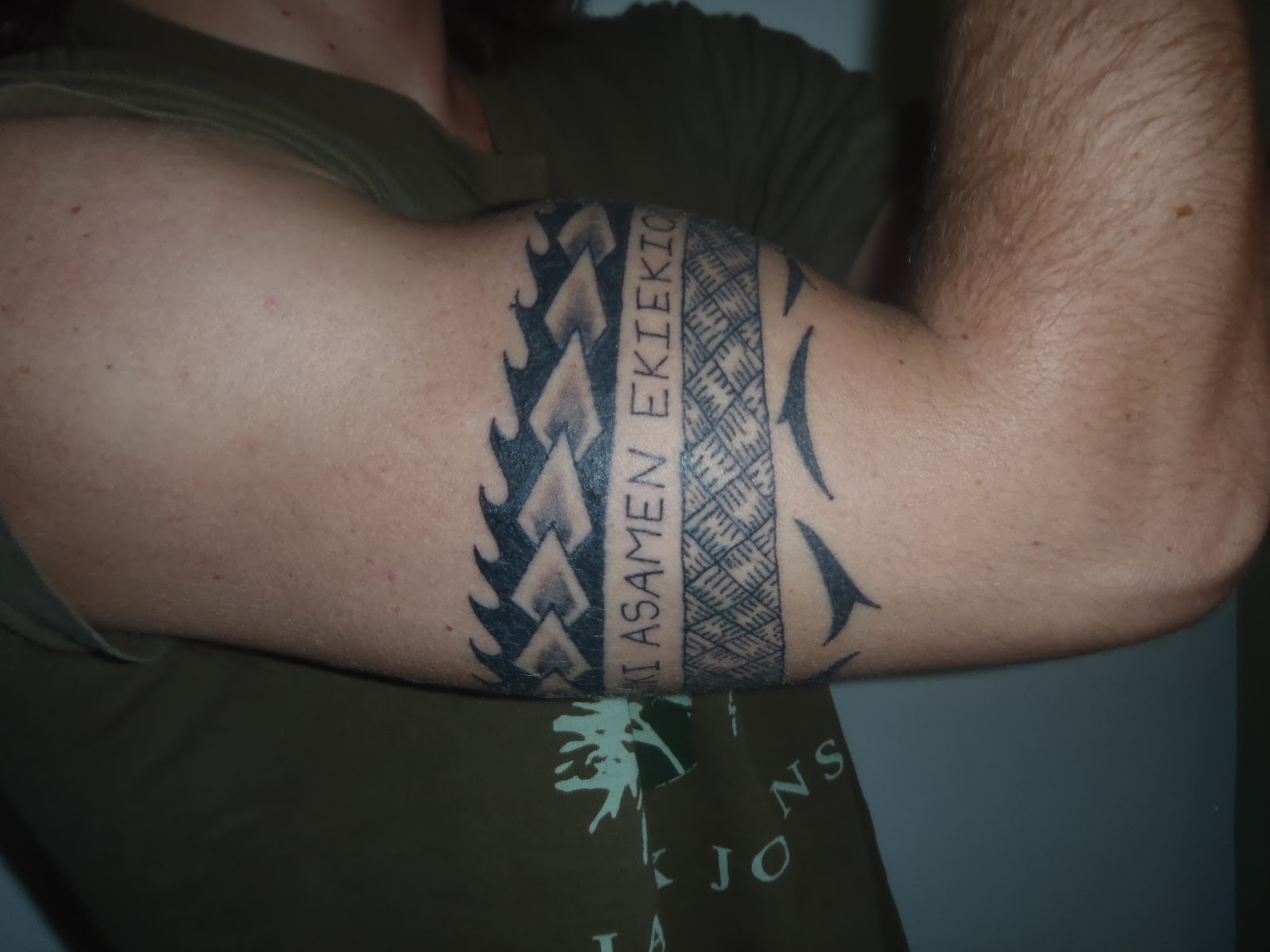
            It’s probably pretty obvious that I am spurting out this tattoo philosophy for a reason. I got a tattoo. I’ve been mulling over the idea since the beginning of my service here and been developing plans for exactly what I wanted. The phrase in the center of the tattoo took a lot of fine-tuning before I was happy with its syntax and the decorative island symbols all have personal meaning to me.  I decided to put it in the form of an armband on my right arm. A bicep can be covered up in formal occasions and the right arm is the masculine orientation in Chuukese. Also for some random reason I have always liked armbands as an accessory. In every single official sports game since the beginning high school that I have participated in (hundreds and hundreds), I have worn a sweatband on my arm. Now I’ve got one for life.
For a long time I tried to get in done in Chuuk, but I couldn't find anybody who could do the procedure legitimately. Battery acid and lime tree thorns are the standard tattoo tools on my island and I felt that it was worth looking around for something more sterile and permanent. So a couple weeks ago when I went to Guam, I cruised around and checked out a few tattoo shops before I found Harv at Low Tide Tattoo. Harv is a retired radio DJ who has been living in the Pacific for decades and exudes a likeable atmosphere in his cozy wood carved room. After talking to the man for a few minutes, I was convinced that he was going to be the guy to put his indelible mark on me.
The process of designing the particulars of my tattoo was a tedious series of trial and error with pictures, paper, pens and tracer ink. Harv was very patient and added his artistic touch to each of my ideas as we moved through the procedure. Eventually I settled on a series of designs and sat down to about 4 hours of needlepoint pricks. The stinging pain was bearable but had a unique hurtful sensation of combing a dentist drill and an eyebrow plucker. At the end of it all, I was left with a permanent armband of four island symbols encasing a Chuukese phrase on my right arm.
Each of the symbols has a particular meaning in the original Pacific culture that they originated, but since I personally picked a unique combination of designs I figured that I could also apply my own personal meaning to each image. The top line is a series of breaking waves and represents “flow”. I often find myself preaching to others about going with the flow and taking life at a relaxed pace. Crazy things happen to all of us, but handling those situations with a positive attitude and levelheaded approach will ensure that the best possible outcomes prevail. You cannot fight flow, you must take everything in stride and adapt to new circumstances. Understanding and embracing the flow of life is an important step in having an enjoyable and thriving existence.
The second line of images is a band of spearheads. My last name is Hunter and the spearhead is an obvious representation of my namesake.  I thought it would be kind of lame to just write my name, whereas a symbolic portrayal is much cooler. An unplanned bonus of the image is that my reputation on my island is as a proficient spear fisherman, so it carries that extra meaning.
 The third line is a Chuukese saying of my own creation, which reads “Suki Asamen Ekiekiomw”. The translation of this phrase is not a perfect one-to-one meaning in English, but it roughly means, “Open the doors of your mind”. I chose this phrase for a variety of reasons. Firstly, it sums up how my Peace Corps experience has altered my personality. I have not only gained a more worldly view by exploring the globe and living in poverty; but by integrating into a foreign culture I have truly come to perceive life and reality from an entirely different perspective. Seeing things through a wider lens has enhanced my understanding of the human condition and its potential, the natural world and its wonders, and the relationship between it all. It is important for me and everyone else on the planet to realize that there is more to the universe than what you see out your backdoor and you should always be willing to embrace the possibility of encountering new ideas and situations. I feel that being open minded about accepting alternative insights and welcoming different standpoints adds to my repertoire of knowledge and makes me a more well rounded person. The phrase is a reminder for me to never stop expanding my thinking and searching for new experiences.
Secondly, the saying is a source of inspiration for me in my continuous search for knowledge and education. I am passionate about learning and understanding anything and everything that comes my way. I want my mind to stay open to incorporate new ideas and thoughts, even if they don't make sense at first. That motivation about the expansion of knowledge leads into another reason for the phrase. I plan on pursuing a career in psychology and as a psychologist my job will basically be unlocking the secrets of the mind. In order to do that, I will need to delve deep into my mind and the minds of others to search for answers. In addition, the phrase serves as is a reminder for me to be non-judgmental. I aspire to refrain from biased judgments against people or things and feel that it is extremely important to stay open minded in that sense. First impressions, categories and covers of books often do not tell the whole story. 
In its overall sense, the words are primarily directed introspectively at myself but can also be seen as a snippet of advice to others. The beauty of the phrase is that it is open to interpretation. An onlooker can take whatever message he feels from the words and I am sure that my relationship with it will change throughout the years. Its variability of meanings and explanations are what make it special to me.
The line below the writing is an image depicting a woven mat of palm fronds. Typically this represents the home and family. Although my family is the most important thing in the world to me, I have expanded upon the meaning of the symbol and allowed it to signify all my social relationships. The complex but elegant connections between me and other people have molded my personality to be what it is today. This intricate web of relationships of my friends, family and acquaintances has defined who I am and is an integral part of my existence. The interconnectedness of the palm fronds represents the network of people that are important to me. Since I greatly value the social relationships that I have forged over the years, I felt it was necessary to make them part of my body because of their role in shaping my soul.
The bottom of the tattoo is a string of swimming dolphins. This particular artistic representation of dolphins originated in Chuuk and was meant to protect from the dangers of the sea and provide good luck. I appreciate having the intelligent mammals watching over me and I also like that they are relevant to my home in Chuuk, but a wandering dolphin also has a deeper meaning to me. When I imagine a dolphin streaking between the waves in a vast ocean, I think of freedom. I don't necessarily mean political freedom because luckily I have never dealt with oppressiveness in my lifetime, but simply a freedom to live life to its fullest. Freedom to pursue dreams and thrive in all that you do.
I am confident that I will never regret this decision to stain my body with inky marks. The significance of its symbolic meaning and its link as a souvenir of Chuuk will never lose its luster. The islands of the pacific and my personal philosophy are now engrained on my body until the end of time. The words and images wrapped around my bicep will forever serve as a reminder for how I want to live my life.

Monday, September 3, 2012

No Shoes, No Shirt, No Problem


Minimize the page on your Internet browser and take a look at your computer’s desktop background. There is a 37% chance that it depicts a tranquil scene of sparkling blue water and a white sandy beach with a single swaying palm tree. You might have this picture as the backdrop of your workspace to provide a glimmer of mental paradise that whisks you away to a fantasyland of carefree relaxation. (Or maybe it just came installed on the computer and you were too lazy to change it). Regardless of the reason that its there, it probably has the effect of inducing a dreamlike yearning for untouched island bliss.
Now take your daydream one step further and imagine stepping into your computer screen and burying your feet in the soft sand as the warm water laps at your ankles. A shallow turquoise sea melts into the powdery blue sky all around you and a crisp salty breeze caresses your cheeks as it flutters by. Tiny hermit crabs ramble along the beach beneath your feet and a school of dolphins playfully frolic in the distance. The only sounds are the gentle whoosh of waves sliding towards the shore and slight rustle of palm fronds quivering above your head. Your worries and concerns float away with the outgoing tide and you are left alone basking in the summer sunlight of the tropics. Welcome to Pisar Island.
            The isolated island of Pisar sits on the outer edge of the Chuuk Lagoon in the remote emptiness of the western pacific. Thousands of miles from the nearest continent and invisible on almost every map, Pisar is an unsullied paradise that seemingly only exists in fairytales. It has sprouted its head above the coral garden that surrounds it and sits atop a mound of crushed seashells that form its body. The rippling blue ocean spreads in all directions and stretches its endless arms towards the feathery clouds on the distant horizon. A couple dozen coconut palms and a few small bushes are the only plants that have taken hold in this nascent geologic wonder. Sand and water fuse together and make this a landscape of uniform beauty.
            In most scenic areas, the observer is drawn in one direction to look at some spectacular site. The difference with Pisar is that there isn’t a particular view that is any better than any other. In a 360-degree circle, each vantage point is equally amazing. Vibrant blue water, lazy drooping palm trees and silky white beaches can be seen anywhere that you look. It’s impossible to escape the visual stimuli of paradise.
            The island is small and basically deserted, but it’s not hard to keep yourself entertained. A short walk across a coral embankment will bring you to the edge of the outer reef and you can enjoy the thunderous crash of whitewater waves. Snorkeling amongst the colorful fish is always invigorating and spear fishing is an option if you are so inclined. The island is just big enough to have a sandy spot in the middle perfect for volleyball, and the space can also serve as an area for Frisbee or bocce ball. Hammocks are strung up from many of the trees and provide a shady respite from the powerful sun where you can catch up on some reading or simply take a nap. However my favorite thing to do at Pisar is just float. Maybe with a tube, maybe without, a leisurely buoyant bath with a beer in hand cant be beat in my book. A couple feet of warm water with a negligible current is the perfect place to dissolve away into absolute relaxation.
            You have to bring your own food and cooking gear, but they provide housing and bathrooms. So its kind of like high class camping…in the middle of the ocean. There are plenty of rooms to sleep in, but I prefer to sway in a hammock at night and fall asleep under the twinkling array of stars. My friends and I usually spend the days eating, drinking and playing games while we soak up the soothing atmosphere of the setting. The time ticks away slowly and the only thoughts running through my head are of sublime tranquility.
                        In my mind Pisar represents ultimate freedom, however I have established a few rules that I have adamantly adhered to on each of my trips to the island. I’m not allowed to wear shoes, put on a shirt, or let a single negative thought enter my mind. Given the circumstances, these personal laws of Pisar are rather easy to follow.

With These Two Hands


Many of the circumstances of my current life conjure up images of what you might imagine to be a stereotypical Peace Corps volunteer experience. I live in a small tin roofed house in the middle of the jungle, I speak one of the most random languages on the planet, I sleep on the floor and do without amenities or luxuries. However, during the last week I think I outdid all cliché moments of my service. I built a school out of discarded scrap wood so that the poverty stricken children of my village could have a place to learn.
The ramshackle mess of crumbling concrete that we used to call our school has just begun a renovation process. This is wonderful news; except for the fact that it means that we have nowhere to have class for the next year. Faced with this problem, the other teachers and I put our heads together and decided that we had to make something happen. So we gathered some of the intact pieces of the torn down building and hammered them together over the remains of another nearby decrepit shack of a building. By straightening out rusty bent nails and cutting off the rotten ends of wooden beams, we were able to pile together a decent supply of materials to begin our work.
            From early morning until sunset each day, the two other male teachers and I have been working tirelessly under the scorching sun to construct this random conglomeration of wood and tin that will house a hundred students for the next school year. Through a process of knocking down termite ridden walls and decayed roofing to make way for borrowed plywood sheets and chunks of scrap wood, we have put together a place that we are now proud to call a school (temporarily).
            After finishing the construction of the school and setting up my classroom, I sat in my broken plastic chair at the front of the class and took a moment to soak it all up. This was my class. Literally, it was mine. I built it myself and I was finally going to be a fulltime teacher of an entire grade. In my entire teaching career, I have always floated from class to class and assisted with numerous grades. Now I have a desk, a chair, a blackboard, and students that are all mine.
As I gazed at the discolored mishmash of plywood that made up my wall, my mind began to wonder about the possibilities of the final few months in Chuuk. After a disheartening end to last school year and a summer break to relax, the importance of school had drained out of me. I was just looking towards the end and going to coast out for the last couple of months. But as I sat in that newly constructed room of old wood planks I became rejuvenated with a spirit of excitement and enthusiasm for my last moments on the island.
I put together a mental map of all the things I could do as a 7th grade teacher. A new Peace Corps volunteer is already here to replace me and will be taking over my old responsibilities, which basically allows me to do whatever I want. What I want to do is teach this class of seventh graders in whatever crazy fashion I deem worthy. And that's exactly what I am going to do. I am going to give these kids a few months of education like nothing they have experienced before. This particular group of students holds a special place in my heart (maybe because some of them are my little brothers and sisters) and I am determined to do everything I possibly can to make them excited about school while I still have a chance.
Beyond my duties as a classroom teacher, I have also taken over most of the administrative responsibilities. Our principal is in America having a baby, and I have taken it upon myself to make sure that everything stays on the right track. I have always taken an overly active role in the functioning of our school system, but now I am officially the man. Ive been running staff meetings, organizing schedules and making plans for the year. Our school building is a mess, we have no principal, a new curriculum was just enacted, and we still have all the other problems that have been plaguing us for decades; but I am confident that I will be able to help guide the students and the teachers in a positive direction for the remainder of my service.